

Master Yuvaraj Sowma
Heriditary Vasthu Consultant
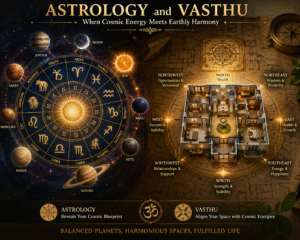
The Northeast in Vasthu: Where Tradition Meets Nature
In Vasthu Sastra, the Northeast (Isanya) is traditionally regarded as one of the most important and auspicious zones of a building. Ancient Vasthu principles often recommend keeping this area open, clean, light and unobstructed, and traditionally associate it with beneficial natural influences.
A fascinating question arises: Can modern science explain why the Northeast was given such importance?
The answer requires us to distinguish between traditional Vasthu concepts and what modern physics has actually demonstrated.
Earth, the Sun and the Northeast
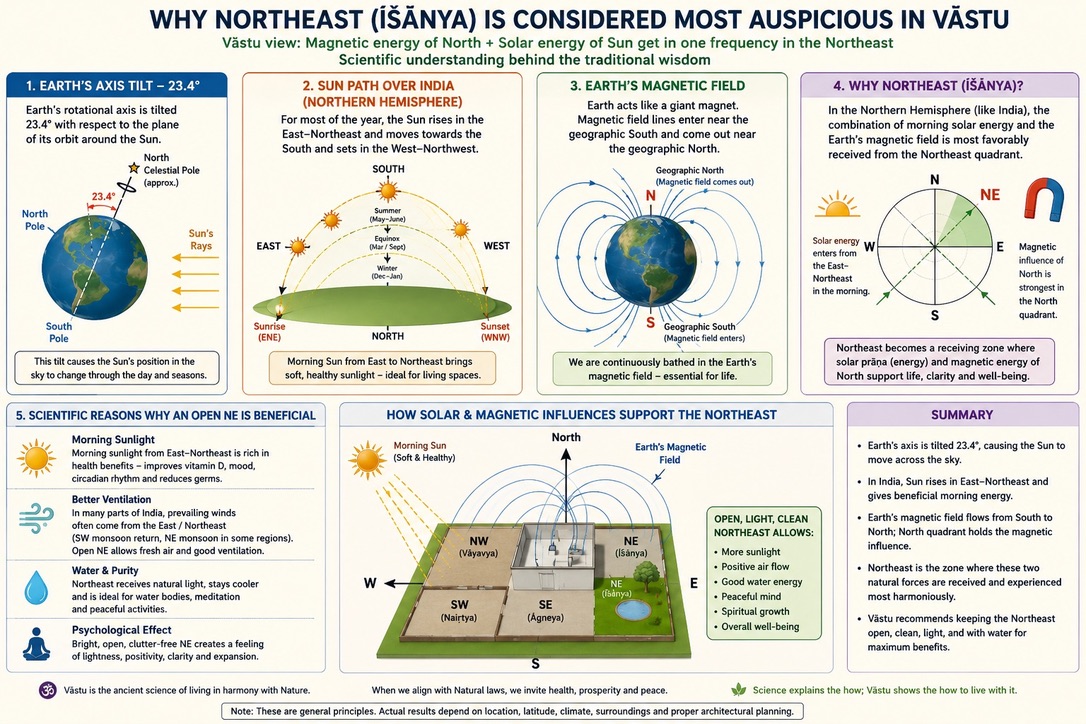
Earth’s rotational axis is tilted by approximately 23.4° relative to the perpendicular to its orbital plane. This axial tilt is responsible for the changing seasons and causes the Sun’s apparent path across the sky to change throughout the year.
India lies in the Northern Hemisphere, and sunlight from the eastern part of the sky is especially important during the morning. An appropriately designed eastern or northeastern side of a building can therefore receive valuable natural daylight.
Morning light is not merely illumination. Scientific research shows that exposure to natural morning light plays an important role in our circadian rhythm, alertness, sleep–wake cycle and general well-being.
What About Earth’s Magnetic Energy?
Earth has a genuine geomagnetic field, produced primarily by processes in its outer core. A compass aligns with this magnetic field, demonstrating that it is a real physical phenomenon.
Vasthu traditions sometimes describe the North and Northeast in terms of beneficial magnetic or natural energies. However, modern physics has not demonstrated that the Northeast receives a uniquely concentrated magnetic energy that combines with sunlight into a single frequency.
This distinction is important.
We can acknowledge the real existence of Earth’s magnetic field without claiming that the traditional concept of Vasthu energy has already been scientifically proven.
Why Keep the Northeast Open?
There are several practical architectural reasons why an open Northeast can be beneficial, depending on the location and climate.
Natural light: An unobstructed area can bring more daylight into the building.
Morning sunlight: Exposure to morning light can support healthy circadian rhythms and create a pleasant indoor environment.
Ventilation: Openings positioned according to local prevailing winds can improve natural ventilation and indoor comfort.
Landscape and water: Plants, shaded outdoor areas and appropriately designed water features can contribute to thermal comfort, visual quality and psychological well-being.
A sense of openness: A bright, uncluttered space can create a feeling of spaciousness, calmness and positivity.
These are measurable environmental and psychological effects—not evidence of a special supernatural energy field.
Where Vasthu and Science Meet
Perhaps the most interesting way to understand Vasthu is not to force every traditional principle into a modern scientific equation, but to recognisethat ancient architectural traditions often observed relationships between buildings, sunlight, seasons, climate, orientation and human experience.
Vasthu gives these observations a traditional framework.
Science investigates the physical mechanisms behind natural phenomena.
Therefore, it is reasonable to say:
Vasthu identifies the Northeast as a beneficial and receptive zone; modern science can explain several environmental advantages of keeping that zone open, bright and well ventilated—but science has not yet proven the traditional claim that solar and magnetic energies combine there into a single frequency.
The beauty lies in understanding both perspectives without confusing them.
Vasthu teaches us to observe Nature. Science teaches us to measure Nature.
When architecture respects sunlight, climate, ventilation, orientation and human well-being, the ancient wisdom of Vasthu and the principles of modern environmental design can sometimes arrive at remarkably similar recommendations.